Macedonian Immigration to Canada
At the turn of the century, one of the largest
groups of non-British settlers to arrive in Canada were
villagers from the Balkan mountains, then part of the Turkish
Empire. These early residents (and their descendants) call
themselves Macedonians. They speak Macedonian, and have
their own social and economic institutions including churches,
fraternal and self-help organizations, and community-based
enterprise, mainly in Metropolitan Toronto and the southern
Ontario region.
Migration and Settlement
The majority of Macedonians who migrated
to Canada arrived in the aftermath of the Illinden Uprising
of 1903 - a heroic but unsuccessful attempt by Macedonians
to end Ottoman domination.
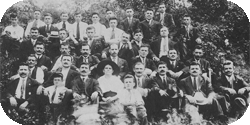
An internal group census in 1910 found about
1090 Macedonians in Toronto, principally from the provinces
of Kostur (Kastoria) and Lerin (Florina), areas which were
once important vilayets of the Ottoman Empire but are now
identified as portions of northern Greece. By 1940 readers
of various Macedonian political and nationalist almanacs
were informed that there were upwards of 1200 families in
Toronto.
The exodus of Macedonians from northern
Greece was to continue in the aftermath of WWII and the
Greek Civil War (1947-49). Immigration from Vardar (formerly
Yugoslav) Macedonia and Pirin Macedonia in Bulgaria also
began in the postwar period. This exodus gained momentum
in the 1960s and continues to the present. Government indices
of population are not helpful in determining the size of
the community because Macedonians fell under the general
heading of those from Turkey, Greece, Serbia (or Yugoslavia)
and Bulgaria.
The most recent Canadian census (1996),
which provides for self-declaration of ethnic origin records
30 915 Macedonians in Canada - the sum total of individuals
making single- or multiple-group responses. Centered in
Metropolitan Toronto, small groups of Macedonians could
also be found elsewhere in Ontario in Cambridge, Guelph,
Hamilton, Kitchener/Waterloo, Markham, Mississauga, Newmarket,
Niagara Falls, St Catharines, Thornhill, Thorold and Windsor.
Community spokespersons believe that there are actually
100-150 000 Macedonians in Canada.
Many early Macedonian immigrants found industrial
work in Toronto, either as factory hands or labourers in
abattoirs, local sheet metal industries, or iron and steel
foundries. From these jobs, they quickly progressed to the
ownership of a great number of restaurants, grocery stores
and butcher shops. Macedonian entrepreneurs and their descendants
eventually employed their numerical strength within the
food service industry as a catapult into a variety of larger
and more sophisticated ventures. The majority of Macedonians
today are employed in the professional, clerical and service
sector of the economy.
Social Life and Community
The social life of early Macedonian immigrants
revolved around mutual and benevolent societies established
on the basis of village or place of origin. Such Macedonian
brotherhoods and benevolent organizations such as Zhelevo,
Banitsa, Buf, Oshchima and numerous others operating in
Toronto became valuable storehouses of comradeship, job
information and worksite strategies.
In the postwar period the Macedonian mutual
benefit societies and brotherhoods evolved into social and
national clubs, playing a role as centres of immigrant culture
as members' working conditions and incomes became subsumed
under the headings of social insurance and workers' compensation.
Since 1970, Macedonian ethnocommunity group
life has grown and now serves a number of special interests
and needs. A number of business and professional associations
have been established including the Canadian Macedonian
Restaurant Co-op, which was founded in 1979; the Canadian
Macedonian Business and Professional Association (1992);
and the Macedonian Canadian Health Professionals' Association,
formerly the Macedonian Canadian Medical Society (1992).
Youth and student groups include the Macedonian Association
of Canadian Youth, which was founded in 1992; the Ryerson
Association of Macedonian Students (1992); and the Association
of Macedonian Students at the University of Toronto, which
was granted official recognition as a university campus
group in 1989.
Religion, Cultural Life and Education
Macedonians belong to the Eastern Orthodox
branch of Christianity. They established SS. Cyril and Methody
Church in Toronto in 1910. It united immigrants from many
different villages into a single religious community.
The early immigrants to Toronto and their
descendants founded 2 additional churches that are either
under the spiritual jurisdiction of the patriarch in Bulgaria
or are part of a Bulgarian diocese within the Orthodox Church
in America. They are St. George Macedono-Bulgarian Orthodox
Church, which was founded in 1941, and Holy Trinity Macedono-Bulgarian
Church, which was founded in 1976.
Postwar arrivals to Canada subsequently
founded Macedonian Orthodox parishes under the spiritual
jurisdiction of the Metropolitan and Holy Synod of the Macedonian
Orthodox Church in Skopje. They are as follows: St Clement
of Ohrid, which was founded in Toronto in 1962; St Dimitria
of Solun, which was founded in Markham in 1992; St Ilija,
which was founded in Mississauga in 1979; St Sunday, which
was founded in Ajax in 1993; and St Naum of Ohrid, which
is located in Windsor.
The community has also created a number
of group newspapers, radio and television programs, folkdance
troupes, sporting organizations and historical and literary
societies.
Newspapers include Makedonska Tribuna/Macedonian
Tribune, the weekly voice of the Macedonian Political (Patriotic
since 1952) Organization, which was founded in Indianapolis,
Indiana, in 1927; United Macedonians, the quarterly of the
United Macedonians of Canada Organization, is published
in Markham; and the monthly, Makedonija/Macedonia, was founded
in 1984 and is published in Scarborough.
Radio programs include Glas od Makedonija/Voice
of Macedonia, Makedonski Svet/Global Macedonia and Makedonski
Zrak/Macedonian Ray. Television programs include Makedonska
Narodnost/Macedonian Nation and Makedonski Koreni/Macedonian
Heritage.
The children of Macedonian immigrants are
integrated in the mainstream of Canadian cultural life,
and also figure prominently in the professional fields of
law, medicine, science and technology, education, sports
and recreation, and the arts and entertainment industry.
The Macedonian language belongs to the South
Slavic group of languages. Various dialects of the language
are spoken and maintained in the home and the literary language
is taught to children in community and school heritage language
classes.
Suggested Reading R.F. Harney and Harold
M. Troper, Immigrants: A Portrait of the Urban Experience,
1890-1930 (1975); Harry V. Herman, Men in White Aprons (1978);
Lillian Petroff, Sojourners and Settlers: The Macedonian
Community in Toronto to 1940 (1995).
See one of the truly great Canadian novels,
Michael Ondaatji's In the Skin of a Lion, about Macedonian
labourers in urban Canada in the 1920s.
With permission from the author,
Dr. Lillian Petroff
[Sojourners
& Settlers: The Macedonian Community in Toronto to 1940]
- - - - - - - - - - - - -
- - - - - - - - - - - - -
The Canadian Macedonian Historical Society
is a non-profit, charitable organization, providing all
Canadians a perspective on Macedonian history and culture.
Our objective is to develop pride and awareness
amongst our members and within the entire Canadian community
as to who we are, where we came from, and where we are going.
The Historical Society is supported by volunteers
and funded through programmed events and donations. If you
would like to support the Society by making a donation please
click
here.
|